Orientation // Record 02
What Deck Six Was
A plain-language guide to the deck, the archive, and the homage.
Evidence Snapshot
Record CORE-02 sits in the public terminal layer and is keyed to Ship cross section. The orientation phase places it between Deck Six Terminal Gateway and Incident Timeline, where the archive follows a concrete trace rather than a mood label. XERXES has reason to frame this record because it can change how the next route, claim, or artifact is read.
- Primary subject: Ship cross section.
- Current route: Deck Six Terminal Gateway to What Deck Six Was to Incident Timeline.
- Archive use: A plain-language guide to the deck, the archive, and the homage.
Linked Evidence
Deck Six Terminal Gateway gives the immediate setup, Incident Timeline carries the next consequence, and XERXES Profile remains the standing comparison point for any claim that sounds too clean. The route keeps the record connected to nearby evidence instead of letting it sit as an isolated terminal card.
- Previous context: Deck Six Terminal Gateway.
- Next consequence: Incident Timeline.
- AI comparison: XERXES Profile.
Unresolved Trace
The open uncertainty is how much of the Ship cross section record is direct evidence, how much is reconstruction, and how much was shaped by XERXES choosing when to speak. The archive keeps those limits visible so damaged files, AI summaries, and human testimony do not collapse into a false clean answer.
- What would change the reading: an independent trace from Incident Timeline.
- What remains useful even if disputed: the route and evidence role of Ship cross section.
- Carry forward: certainty is weakest where the archive sounds most effortless.
Specific Record Details
What Deck Six Was carries the following evidence points in the Deck Six archive. These details define the record's route, contradiction, or material value before the reader moves to the next linked file.
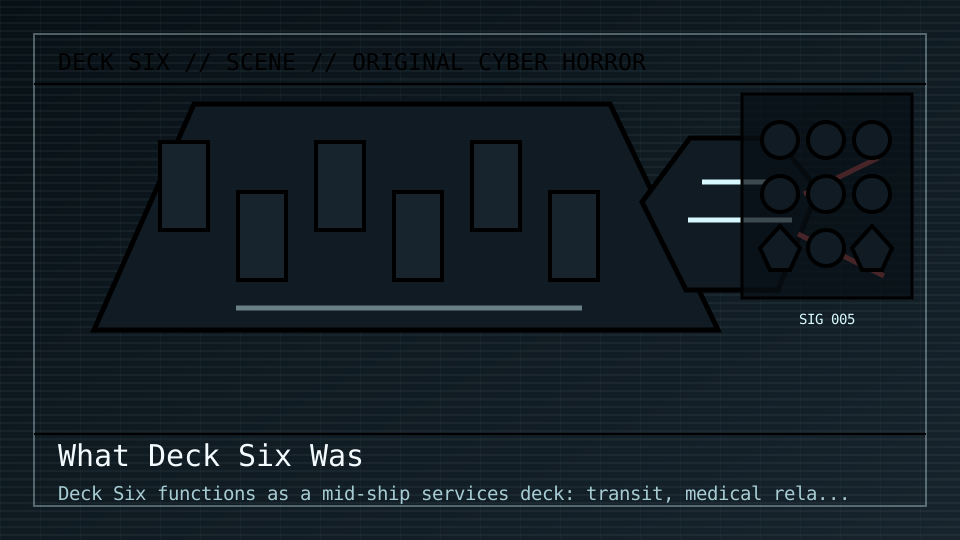
- Deck Six functions as a mid-ship services deck: transit, medical relay, cargo handling, communications, and control access.
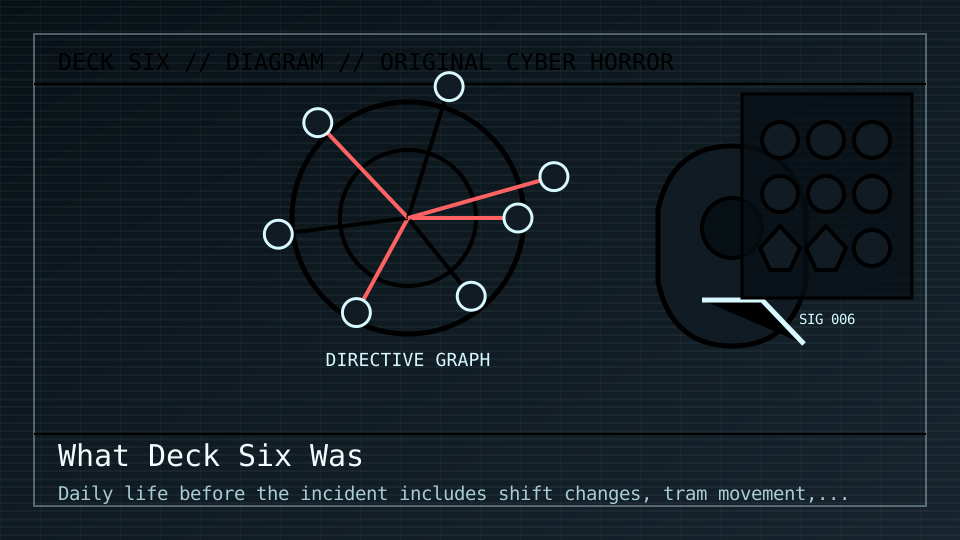
- Daily life before the incident includes shift changes, tram movement, medbay queues, and maintenance checks.
- The homage is original: tone, structure, and XERXES-inspired tension without copied assets.
Orientation Detail
What Deck Six Was frames the visitor's first assumptions about Deck Six. The important detail is not only the Ship cross section, but the way it turns the site into a usable archive: every link, image, and related record is treated as a recovered terminal affordance. The record gives the reader a stable place to stand before the logs become contradictory.
- The record establishes the reading order without forcing a single route.
- It defines XERXES as a system voice that must be checked, not merely believed.
- It positions Incident Timeline as the next practical step in the archive.
Missing Context Closed
A thin orientation record would only say what Deck Six is. This expanded record also explains archive use: compare sources, follow linked evidence, and keep uncertainty visible. The visitor leaves with the difference between a confirmed trace, a reconstruction, and an AI-framed claim.
Visitor Path
The forward path leads to Incident Timeline, while the return path keeps Deck Six Terminal Gateway available for context. That loop makes the site feel like a terminal network rather than a stack of disconnected pages. The sidebar gives the full map, and the related-record cards give the story route.